


With thanks to Dan Licence, an Education Mental Health Practitioner, for writing this blog for us.
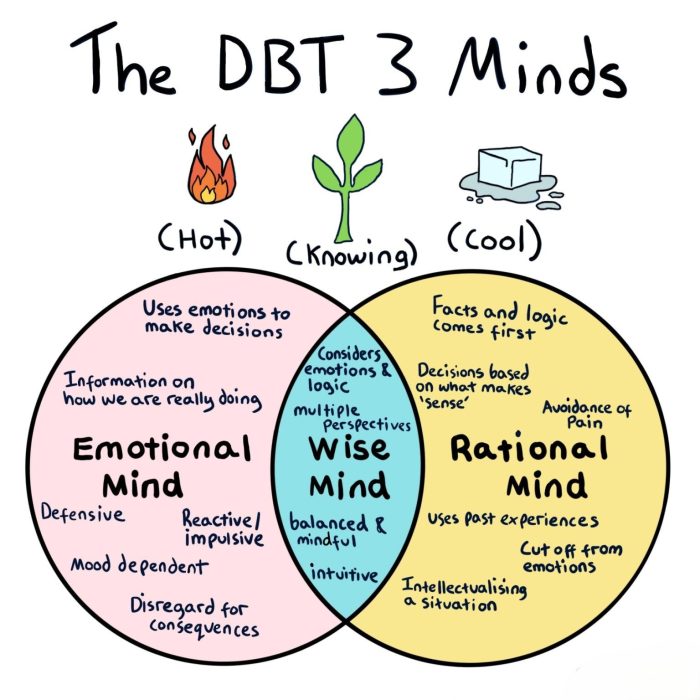
Working with students can often feel like you’re dealing with three different people – sometimes intensely emotional, sometimes calm and thoughtful, sometimes surprisingly logical. In Dialectical Behaviour Therapy (DBT), these differing states are characterised by the 3 minds: Emotional Mind, Rational Mind, and Wise Mind.
Emotional Mind is when feelings are in the driver’s seat. For teens, this can look like slamming doors, crying over “nothing,” or explosive reactions that seem to come out of nowhere. This is in part due to areas of the brain associated with impulse control and emotional regulation being underdeveloped throughout adolescence. When your young person is in Emotional Mind, it can be very difficult to remedy this with logic. Saying things like “you’re overreacting” or “just calm down” can often make things worse. What does help, however, is validation: “I can see you’re really upset by this” or “I understand that felt unfair to you.” Validation doesn’t mean agreement, or giving in to unreasonable demands. It simply means acknowledging the emotion.
Rational Mind is the opposite. It’s when a young person is able to view a situation through the lens of facts and logic, allowing them to problem-solve and plan effectively. This is where parents or teachers often live: thinking about consequences, rules, and long-term outcomes. Rational Mind is essential when supporting a young person, but on its own, it can feel cold or dismissive. Particularly when they have become overwhelmed by feelings.
Wise Mind is the sweet spot. It’s the integration of emotion and logic. Wise Mind says: “My feelings matter, and I can still make rational decisions.” For parents, Wise Mind might sound like, “I understand why you’re upset, but we still need to talk about what happens next.”
Learning to adopt a Wise Mind is a life skill that can help young people with relationships, stress, and decision-making. Like any skill, it can be strengthened with practice. Simple things like taking a slow breath, stepping away for a moment, or naming the feeling (“I’m stressed and overwhelmed”) can all support learning how to respond, instead of react.
Wise Mind doesn’t mean ignoring emotions or pretending everything is fine. It means respecting feelings without letting them run the show. By creating space between thought and action, we can teach young people that they can experience difficult emotions, yet still make sensible decisions.
For more information on how to support your young person to use their Wise Mind, head over to the following link.
For more information or advice, contact our founder, Lucy Cawkwell, at lucy@octuition.co.uk